Commercial Space
Transducers
Radiation-Hardened Pressure Measurement Built on Discrete Component Architecture
When your program needs a space-rated pressure transducer with flexible component sourcing, low EMI switching electronics and a test data package that reduces NRE, the architecture underneath the sensor matters as much as the spec sheet.
Discrete Component Architecture
Many space-rated pressure transducers rely on hybrid integrated circuit assemblies at the heart of their signal conditioning and DC-DC converter stages. When that IC encounters a supply chain constraint or radiation performance gap, the entire assembly is the problem — and your schedule absorbs it.
Our electronics use discrete components throughout: individual transistors, resistors, capacitors, magnetics and active devices specified and placed separately on the board.
Our designs support live selection of screened or radiation tested components that can be swapped independently with little to no effect on architecture or heritage “qual by sim” selection methodology. Additionally, using discrete components results in a smaller physical footprint enabled by modern discrete component geometries, lower radiated noise through switching frequency control and the ability to replace any single device — the transformer driver, op-amp, voltage reference or converter switch — without touching the rest of the signal chain.
And, when a Grade 1 radiation-hardened op-amp faces an 18-month lead time, we qualify a functionally equivalent heritage component and keep production moving. An integrated subassembly offers no such path.
EEE Parts Selection to the NASA Goddard Standard
Every electrical, electronic and electromechanical part is selected, screened and derated in accordance with NASA EEE-INST-002 — the NASA Goddard Space Flight Center instruction for EEE parts selection, screening, qualification and derating.
Grade 1 compliance applies to active parts including amplifiers, voltage regulators and switching devices, with radiation hardness assessed against the NASA/DSCC parts database and tested where published data is insufficient. The same discrete architecture is also offered as Grade 2 (radiation‑tolerant) and Grade 3 (non‑flight) for engineering test articles and R&D. Because the electrical design is identical across all three, you can validate your system with a lower‑grade, lower‑cost unit early and move to Grade 1 for flight with identical electrical performance.

The practical value of a discrete design is that “heritage” applies at the component level — not the assembly level. When a particular Grade 1 rad-hard gate driver goes long-lead or end-of-life, we evaluate the full database of qualified equivalents, confirm electrical and radiation performance within the circuit context and qualify the substitution in weeks rather than the months that are typical for a full re-qualification cycle. Our design team’s background spans multiple generations of space instrumentation programs, so these tradeoffs draw on direct experience with how individual components perform across mission environments, not merely datasheet comparisons.
DC-DC Converter Design
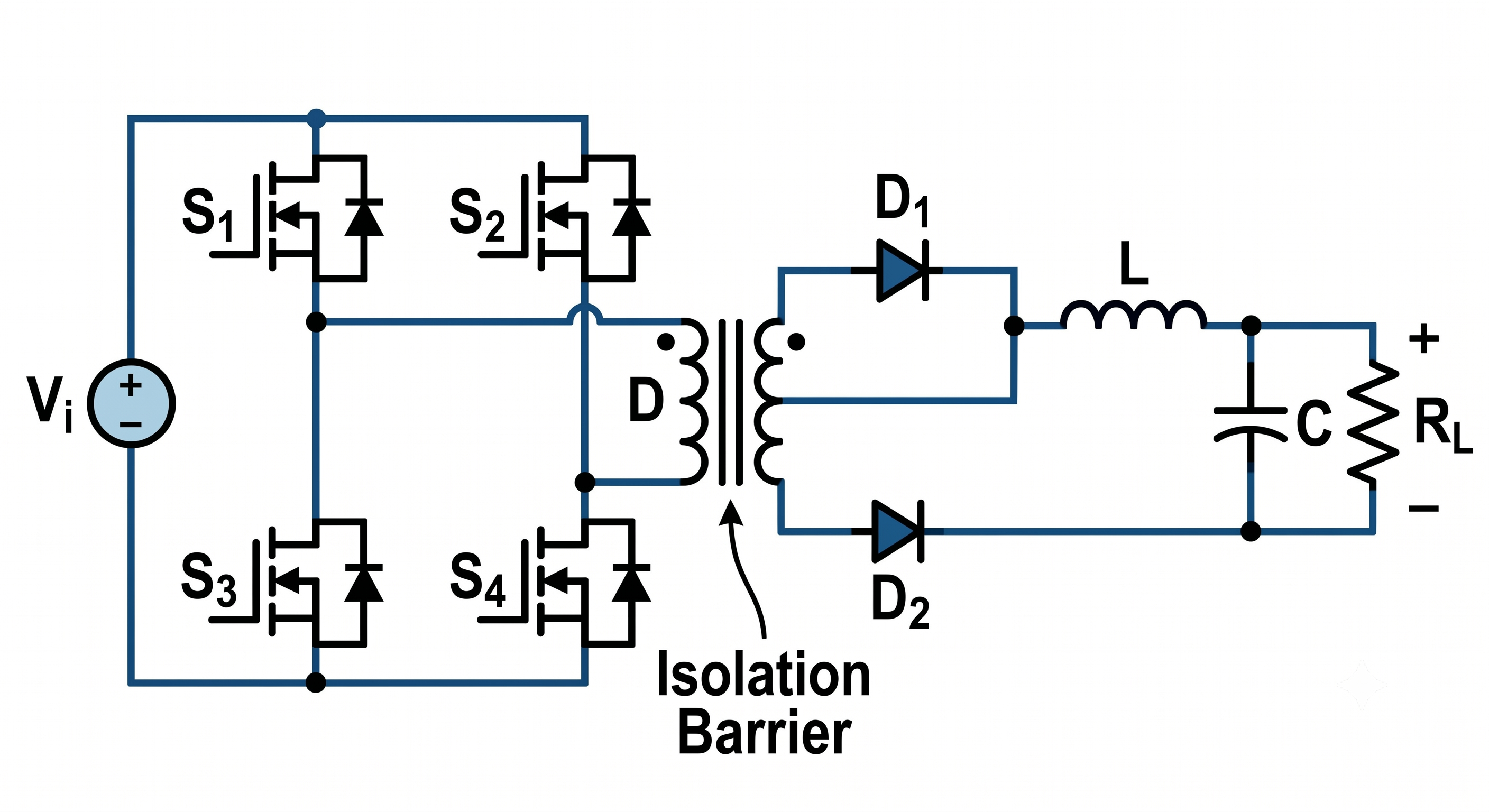
The DC-DC converter is where discrete component architecture delivers its most measurable performance advantage. Conventional space transducers use large magnetic transformers switching at 30–40 kHz to create isolation. Our converters operate at 250–450 kHz, depending on the design, using a communications-grade transformer in a low-power topology that draws 1–1.5 W total.
The higher switching frequency reduces the transformer’s physical size and mass compared to traditional low-frequency designs, and it pushes the switching noise spectrum well above the measurement band, so conducted and radiated noise does not compete with the pressure signal or appear in the frequency bands your onboard communication systems use. We can tune the specific switching frequency during design to avoid notch frequencies relevant to your vehicle’s RF architecture — something a fixed integrated power stage cannot offer.
EMI, EMC and RFI Performance for Spacecraft Integration

Compliance
Our space transducers are designed and tested for compliance with MIL-STD-461, which governs conducted emissions, conducted susceptibility, radiated emissions and radiated susceptibility for electronics installed in military and space platforms.

Frequency Tuning
Keeping the DC-DC converter switching frequency above 250 kHz ensures that noise harmonics are manageable at the transducer’s radiated output. Lower switching frequencies generate more noise octaves that can interfere with spacecraft communication bands, and the discrete architecture resolves that tradeoff at the component selection stage rather than through post-design filtering.

Test Data
EMI, EMC, RFI, vibration and shock test data is documented and available as part of the standard product package. If your program’s test parameters fall within the envelope of that existing data, you may be able to accept qualification by similarity rather than commissioning a full independent test campaign.
Radiation-Hardened Models for Orbital Applications
The radiation-hardened transducer line addresses low Earth orbit, medium Earth orbit and geosynchronous satellite programs where cumulative ionizing dose and single-event effects determine component selection. Rad-hard active parts are selected to meet Grade 1 requirements under EEE-INST-002, and radiation testing is performed where parts database information is insufficient.
Because the design uses discrete components, when a specific rad-hard device — whether a transformer driver, voltage reference or amplifier stage — encounters supply chain constraints, we can qualify an alternate component with equivalent or superior radiation performance. The qualification basis is the part’s heritage in the NASA/DSCC database and its electrical performance, not a single-source dependency.
For your program, this translates to shorter lead times than designs built around fixed integrated rad-hard subassemblies.

Applications: Launch, On-Orbit and Planetary Entry
These transducers are configured for the pressure measurement applications that appear across launch vehicle and spacecraft programs.

Launch Vehicles
- Propellant tank ullage pressure monitoring during loading, pressurization and flight
- Rate control thruster feed line pressure — fuel and oxidizer manifold sensing for thrust vector management
- Attitude and position thruster manifolds — low-range absolute and gauge measurement for RCS system health
- Entry, descent and landing instrumentation — atmospheric pressure sensing across hypersonic, supersonic and subsonic flight phases, including aeroshell stagnation and backshell measurement points

Satellites and On-Orbit Platforms
- Fuel tank pressure monitoring for GEO, MEO and LEO propulsion systems
- Position thruster line pressure — pre- and post-valve sensing for station-keeping maneuver verification
- Propellant mass estimation by pressure-temperature inference — tank ullage measurement for remaining propellant budget tracking through end of mission
- Oxidizer and bipropellant system sensing — compatible with hydrazine, MON and high-pressure systems
Configuration options, including pressure range, electrical interface, connector and pressure reference type, are selected based on your application parameters, minimizing non-recurring engineering against a validated baseline.

Test Data Package and NRE Reduction
One recurring cost in space instrumentation procurement is the NRE charge associated with qualifying a component that does not yet have test data relevant to your program. We address this through the universal space flight transducer approach: a standard product design with a comprehensive, publicly available test data package covering vibration profiles, shock spectra, EMI/EMC curves and thermal performance.
When your program’s test requirements fall within the envelope of that existing data, you can present the package to your prime contractor or government customer and accept qualification by similarity, avoiding the schedule and cost of an independent test campaign. If you’re a Tier 2 supplier flowing down prime contractor requirements, having ready access to test curves and performance specifications shortens the review cycle between you, your prime and their customer significantly.
Where the existing data doesn’t cover your full requirement, we’ll work with your team to define the delta test plan and complete it against the existing test baseline.
Contact an EngineerFrequently Asked Questions
Talk to a Space Instrumentation Engineer
Our engineers come out of space instrumentation programs and understand how EEE parts requirements, supply chain constraints and qualification data interact at the program level. Share your pressure range, mission environment and schedule requirements and we’ll identify whether the standard configuration covers your needs or where a delta analysis makes sense.
Discuss Your Application




[email protected] | 973-616-6900
2 North Corporate Drive, Riverdale, NJ 07457 | Sigma-Netics, Inc. © 2026